
Nygel Humphrey
17/07/2026
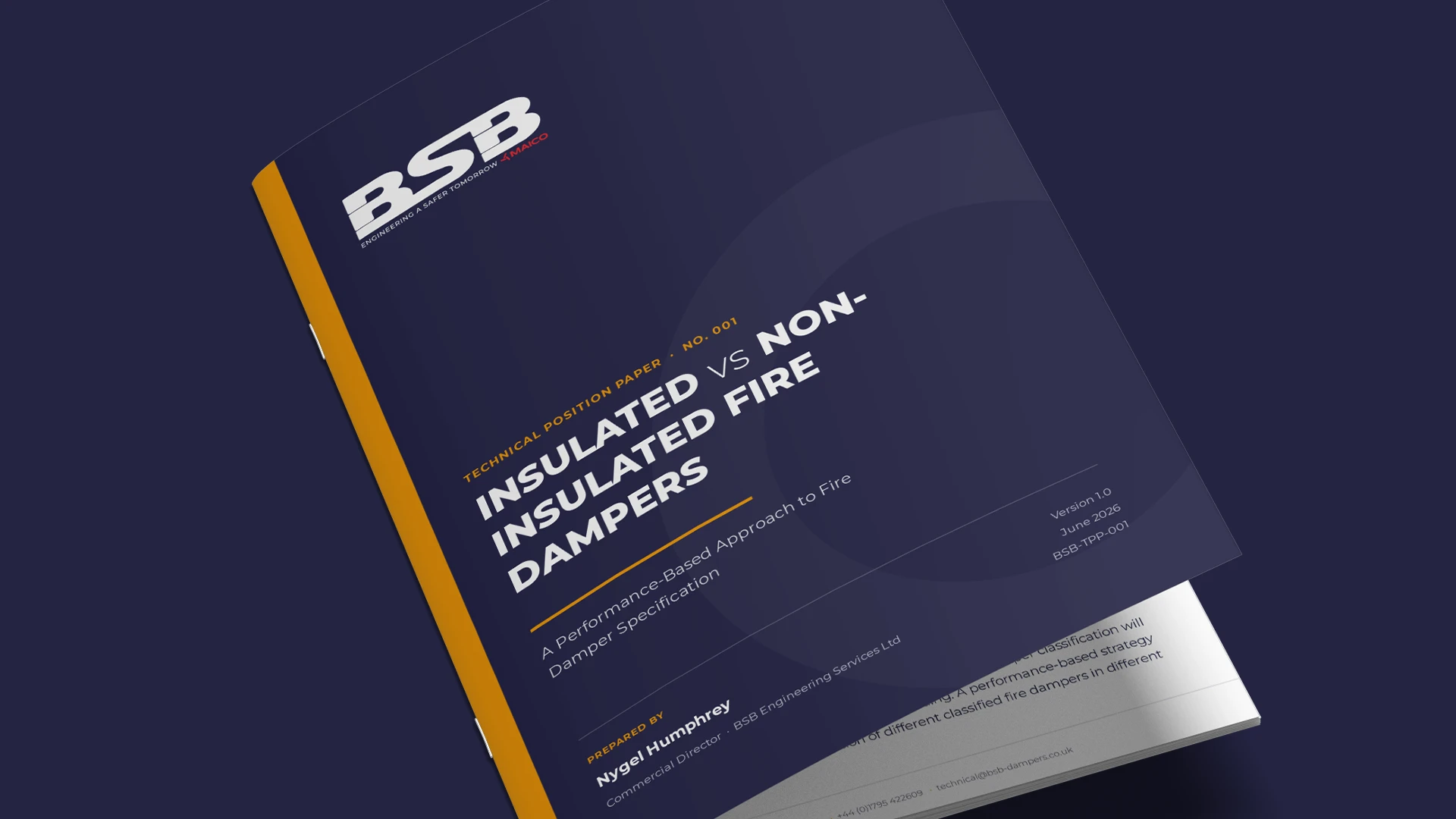
BSB Engineering Services has released a new technical position paper to support clearer, evidence-based fire damper specification across UK building services.
The paper has been developed to help consultants, fire engineers, contractors and building safety professionals understand how fire damper classification should be considered in relation to the building fire strategy.
The paper looks at E, ES, EI and EIS classifications, explaining how each relates to demonstrated fire performance and how the correct specification should be determined by the required performance of the compartment boundary.
It has not been written to promote one classification over another. Instead, it sets out a practical framework for selecting the appropriate fire damper based on the fire strategy, tested installation, supporting construction, access for inspection and long-term maintenance.
With both insulated and non-insulated fire damper solutions available from its UK manufacturing base, BSB is able to support project teams where different compartment boundaries call for different demonstrated performance.
That distinction is important. Fire damper specification should not start with the assumption that one classification is always the right answer. It should start with the building fire strategy. In some locations, integrity and smoke leakage performance may satisfy the requirement.
In others, insulation performance may form part of the engineering objective.

The position paper explains how fire damper classification should be applied in practice, moving from the building fire strategy through to the required performance of each compartment boundary.
It covers the role of integrity, smoke leakage and insulation performance, and considers how E, ES, EI and EIS classifications should be selected according to the application rather than by default.
The paper also looks at spatial coordination, tested installation details, supporting construction, maintenance access and whole-life considerations.
These factors are important because a correctly specified damper must also be capable of being installed, inspected and maintained in line with its tested arrangement.
A structured specification methodology is included to help project teams ask the right questions before selecting a damper, including whether smoke leakage or insulation performance is required, whether the installation is supported by test evidence, and whether the selected product can be accommodated within the building services design.
The paper has been prepared to encourage more consistent discussion around appropriate specification, classification, application and evidence. It supports a performance-based approach where the selected damper is matched to the required performance of the compartment boundary, aligns with the fire strategy and is supported by recognised testing and installation detail.
Printed copies of the paper are now available by request.
To request your copy, click the link here or the link below.
