
In modern building design, fire safety and air management go hand-in-hand. Whether you’re working on a healthcare facility, commercial office, or mixed-use development, the correct specification of fire dampers and smoke control dampers is essential to ensure compliance, performance, and occupant safety.
At BSB Engineering Services, we work closely with building services consultants, contractors, and designers to help you choose the right product for every application — backed by detailed technical data, performance testing, and decades of engineering experience.
While often mentioned together, fire dampers and smoke control dampers perform distinct differing— but equally vital — roles within a building’s HVAC system.
Fire dampers maintain compartmentation, normally where a ventilation duct passes through a fire compartment barrier.
Smoke control dampers maintain compartmentation when closed but in the event of a fire, will open on the fire floor, allowing the evacuation of smoke, giving a clear path for occupants to escape and fire services to enter to extinguish the fire.
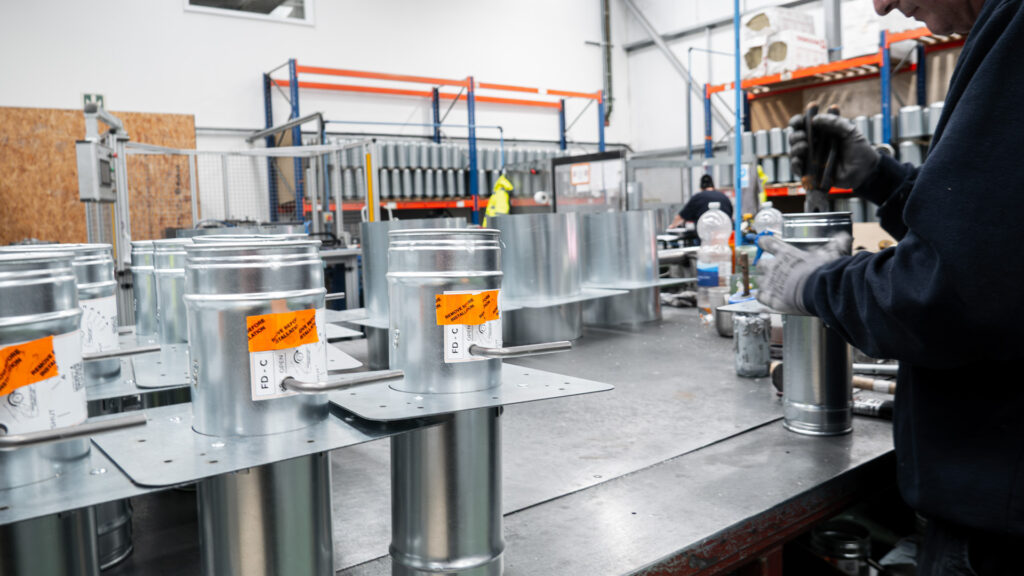
Mechanical Fire dampers in the event of a fire will automatically close when the temperature rises, preventing fire from compromising the compartment through ventilation ductwork.
In accordance with Approved document B they are required to be ‘E’ rated for fire integrity
Typical features include:
BSB’s FD-C, FD-R and FD Series dampers combine these capabilities and are fully third party tested and certified for guaranteed performance, supporting both life safety and protecting buildings.
Motorised Fire dampers are a passive fire protection component — their job is to contain fire for a specified duration and limit the spread of smoke and protect escape routes and critical zones, like areas of sleeping risk.
BSB’s FSD-C, FSD-TD and AT-FSD Series of dampers combine these capabilities, available with a range of 24V or 230V actuators, Electro mechanical or addressable control solutions, and are fully third party tested and certified for guaranteed performance, supporting both life safety and protecting buildings.

Smoke control dampers, on the other hand, are active control devices. They operate as part of a smoke control or extraction system, working to limit or redirect smoke movement in the early stages of a fire and maintain compartmentation when closed.
The smoke control damper will automatically open to extract smoke from a specific area during a fire (cause and effect) while keeping all other dampers closed to maintain compartmentation and limit smoke spread.
They are:
Smoke control dampers form part of an engineered smoke control strategy, ensuring visibility for evacuation and access for fire services.
Choosing the right damper for your project can be complex. Factors such as fire strategy, system design, fire compartment construction all play a part.
That’s where BSB’s technical team can help.
We offer:
Our team are always available to advise on compliance, installation detail, and best practice.
Resources for Installers
BSB product is supported by a comprehensive range of BIM Models, Datasheets, Installation & Operating Manuals (IOMs), and Declaration of Performance (DoP) documents.
These resources ensure:
All technical documents are available to download from the BSB website, or on request from our technical support team.
To further support consultants and installation co-ordination, BSB offers a CPD presentation focused on:
Our CPD sessions are ideal for design teams, specifiers, and contractors looking to enhance their knowledge and meet industry competency requirements.
At BSB, we don’t just manufacture dampers — we engineer solutions.
From early-stage design advice through to commissioning and ongoing support, our team ensures every product we supply meets the highest standards of safety, compliance, and performance.
To discuss your next project, download our technical datasheets, or book a CPD session, visit
👉 www.bsb-dampers.co.uk
