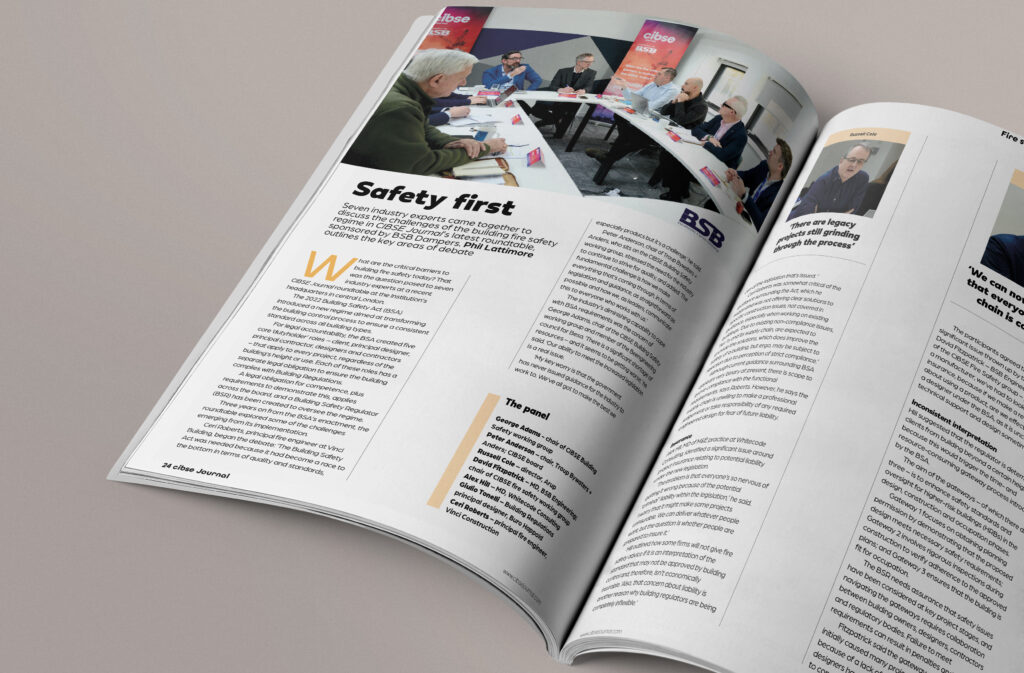
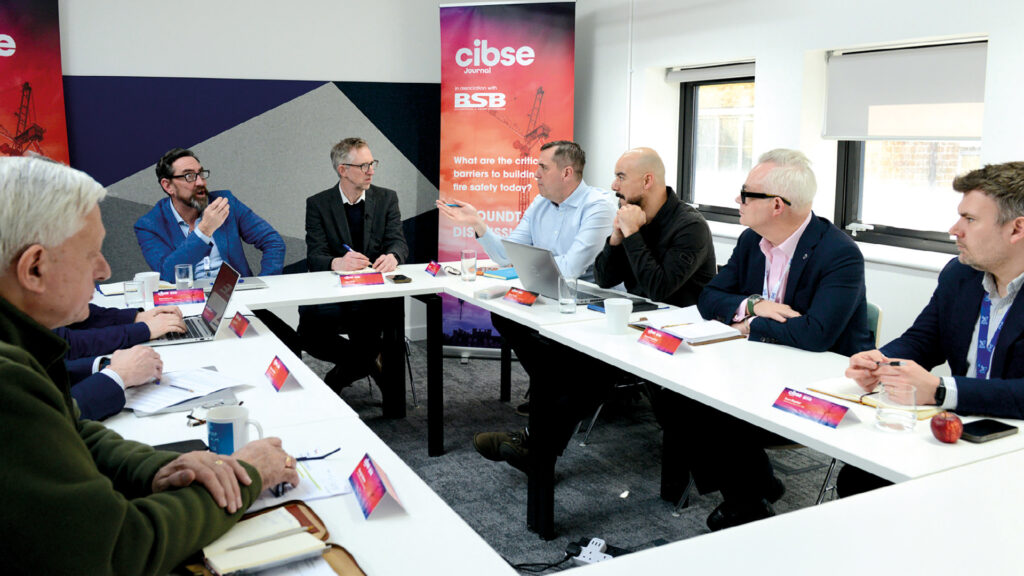
Seven industry specialists recently came together at CIBSE’s headquarters to examine a question that continues to shape the Building Safety Act landscape: what barriers still stand in the way of safer buildings?
Chaired by David Fitzpatrick, Managing Director at BSB Engineering Services and Chair of the CIBSE Fire Safety Group, the roundtable brought together perspectives from across design, engineering and construction. The discussion focused less on theory and more on what is happening in practice as the regime beds in.
There is broad support for the intent behind the Building Safety Act. Defined dutyholder roles, a formalised approach to competence and oversight from the Building Safety Regulator are all seen as necessary steps towards consistency.
What is less settled is how that framework translates into day-to-day delivery.
Peter Anderson of Troup Bywaters + Anders captured the challenge: “The fundamental challenge is how we make everything that’s coming through, in terms of legislation and guidance, as straightforward as possible and how we, as leaders, communicate this to everyone who works with us.”
That gap between legislation and application continues to test project teams, particularly where guidance is still evolving or open to interpretation.
The Act has brought a marked shift in responsibility. Every dutyholder now carries defined legal obligations, and that is changing how decisions are made and recorded.
There is greater scrutiny on design intent, product selection and compliance evidence. At the same time, the risk attached to those decisions is more visible.
Alex Hill of Whitecode Consulting highlighted the impact this is having: “The problem is that everyone’s so nervous of getting it wrong because of the potential ‘criminal’ liability within the legislation. I worry that it might make some projects uninsurable.”
That caution is influencing behaviour across the supply chain, particularly where professional judgement is required.
For manufacturers, the shift is equally significant. As David Fitzpatrick noted during the discussion: “If we recommend using a product, we are effectively liable as a designer under the BSA, as it is unclear between technical support and design sometimes.”
That blurred line between advice and design responsibility is one of the more complex aspects of the new regime, and one that requires careful handling.
The introduction of the gateway process has brought a more structured approach to demonstrating compliance, particularly for higher-risk buildings. Early experiences saw a high number of rejected submissions, often linked to a lack of detail or incomplete coordination.
There are signs that this is improving as teams adapt, but consistency remains an issue. Different interpretations from those reviewing submissions can create uncertainty, especially at Gateway 2.
Even so, the process is driving better behaviours. Design teams are engaging earlier, and decisions are being tested more rigorously before they reach submission.
Hill reflected this shift: “There are a lot more conversations happening earlier about costs, about product selection.”
That earlier scrutiny is reducing late-stage changes and placing greater emphasis on getting decisions right the first time.
A more defined approach to competence is one of the regime’s strongest features. Organisations are now expected to demonstrate capability, not simply assume it.
This has led to more formal processes, clearer accountability and a stronger focus on documented evidence. Product selection, in particular, is under greater scrutiny, with verified test data and appropriate certification forming a core part of compliance.
Designers are expected to stand behind their specifications, and products must be demonstrably suitable for their intended application. That has raised the bar across the board, reinforcing the need for clarity and accuracy in technical information.
What the roundtable made clear is that the industry is still adjusting. Resource constraints, evolving guidance and differing interpretations are all contributing to the current friction.
At the same time, the direction of travel is understood. The framework is pushing the industry towards greater accountability, better coordination and a more disciplined approach to safety.
For BSB Engineering Services, that shift aligns closely with how we support the sector. Clear product data, robust test evidence and well-defined application guidance are no longer supplementary. They are essential to helping designers and contractors demonstrate compliance with confidence.
As the regime continues to mature, that clarity becomes increasingly important. The ability to stand behind a decision, with evidence that holds up at every stage of the gateway process, is
Watch the roundtable video to hear directly from the panel and understand where the industry is aligning, and where questions still remain. What will ultimately remove many of the barriers discussed around the table.