
Nygel Humphrey
07/09/2026
Fire damper specification can appear straightforward: identify the required fire resistance, select a suitable product and add it to the schedule.
In practice, there is considerably more to consider.
A fire damper forms part of a wider passive fire protection strategy. Its suitability depends not simply on its classification, but on the fire strategy, application, supporting construction, installation method and available test evidence.
With greater industry emphasis on competence, accountability and evidence-based decision-making, understanding why a product has been selected is becoming just as important as recording what has been specified.
So, what does a good fire damper specification look like?
The first question shouldn’t be:
Which product do I need?
It should be:
What is the fire strategy trying to achieve at this location?
Where ventilation ductwork penetrates fire-resisting construction, the selected solution needs to support the intended performance of that compartmentation.
Fire resistance, smoke leakage and, where required, insulation performance should therefore follow the fire strategy and application.
This is particularly relevant when considering E, ES, EI and EIS classifications. A higher classification should not automatically be interpreted as a better specification. The appropriate classification is the one required by the strategy and supported for the proposed application.
Classification tells us important information about performance demonstrated through testing, but it is only part of the specification.
Specifiers also need to consider the conditions under which that performance was achieved, including the supporting construction, damper orientation, installation method, ductwork arrangement, access requirements and manufacturer’s tested installation details.
Rather than simply asking:
“Does this damper have the required rating?”
A better question is:
“Is there appropriate evidence for this damper, installed in this way, within this application?”
Access to classification information, technical datasheets, installation instructions and supporting test evidence helps project teams make that assessment before products arrive on site.
A technically appropriate product can still create difficulties if its practical installation requirements haven’t been considered early enough.
Available space, access for inspection and maintenance, interfaces with other services and the supporting construction can all influence the suitability of the proposed solution.
Early coordination can identify potential issues before they become problems on site. BIM models, installation details and accurate product information can all support this process.
Good coordination starts before site.
Good specification also needs to survive the journey from design through procurement, installation and handover.
A product schedule may explain what has been specified without necessarily communicating why.
This becomes particularly important when substitutions or alternatives are proposed. An alternative should not be assessed solely because it appears to offer an equivalent or higher classification. It needs to be considered against the original design intent, application and supporting evidence.
Maintaining that information helps project teams make informed decisions and provides a clearer record of what was specified, installed and commissioned.
Good fire damper specification isn’t defined by one product characteristic.
It brings together:
Fire strategy + application + classification + evidence + installation + coordination.
For experienced consultants, these considerations may already form part of established specification processes. For those newer to specification, the principle is straightforward:
Don’t start with the product. Start with what the building needs the product to do.
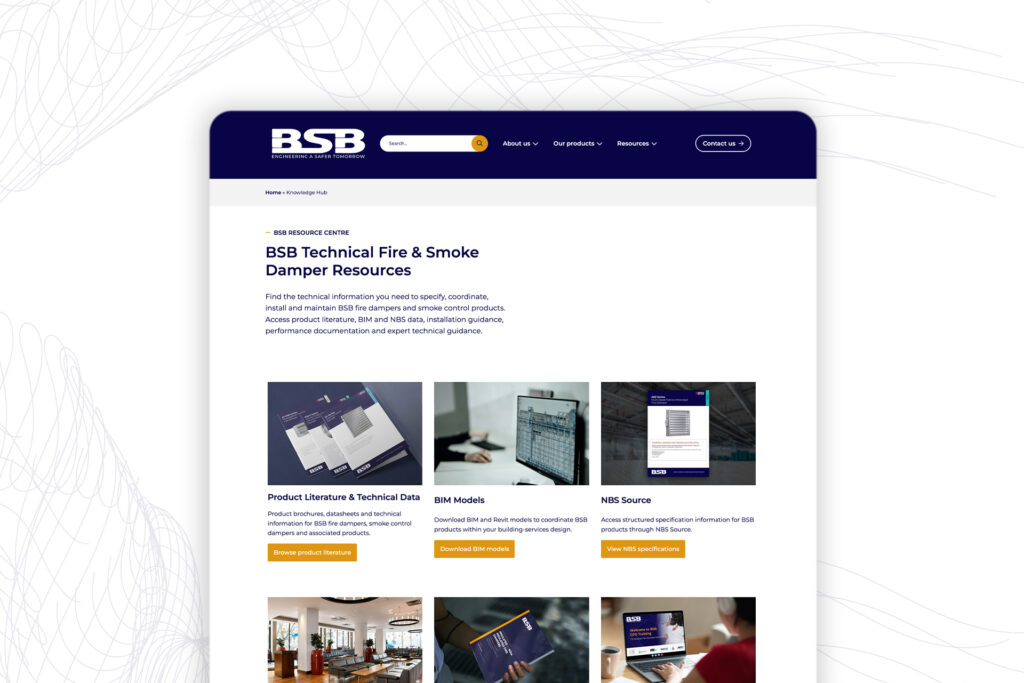
At BSB Engineering Services, we’re also working to make the technical information behind those decisions easier to access.
Our NEW BSB Knowledge Hub, is now live and brings together product datasheets, installation and maintenance information, BIM resources, technical papers, certification, case studies and more in one dedicated online resource.
The aim is simple: to make trusted technical information easier to find and support better-informed specification decisions.
