
Fire damper specification should start with the building’s fire strategy, not simply the product classification.
When designing fire safety systems, understanding which regulatory guidance or design methodology applies to a project is an essential first step.
In England, Approved Document B (ADB), BS 9991 and BS 9999 offer different approaches to fire safety design. The chosen approach can influence how ventilation penetrations are protected, which damper classifications are required and how dampers must operate in a fire.
So, what are the differences, and why do they matter?
Approved Document B is statutory guidance illustrating ways to satisfy the fire safety requirements of the Building Regulations in England. Volume 1 addresses dwellings and Volume 2 buildings other than dwellings. It is an established route to compliance, but not the only possible approach.
For ventilation ductwork crossing fire-separating construction, ADB Volume 2 identifies different methods of maintaining fire separation. Under clauses 10.19 and 10.20, fire dampers are specified with an E classification and what ADB calls ‘fire and smoke dampers’ with an ES classification. The minimum is 60 minutes or the integrity rating of the fire-resisting element, whichever is higher. The correct method, actuation and installation still depend on the application.
These provisions do not establish a universal insulation (I) requirement for fire dampers. Where limiting heat transfer is important, particularly in higher-risk compartments, the fire strategy may call for additional measures or an insulated classification supported by suitable evidence.
BS 9991:2024 provides a code-of-practice approach for residential buildings within its scope. It is an alternative design methodology, not a collection of additional requirements that can simply be added to ADB.
Residential applications demand particular attention to compartmentation between dwellings, shared ventilation systems, protected escape routes and how dampers respond to smoke and fire. The required protection and actuation must be established from the applicable provisions of BS 9991 and the project fire strategy, rather than assumed from the building type alone.
BS 9999:2017 provides a code-of-practice approach principally for non-residential buildings within its scope. Its risk-based methodology considers occupancy characteristics and other aspects of the building’s fire safety design.
Its ductwork provisions can influence whether thermally activated fire dampers are suitable or smoke-detector-actuated ES-rated fire dampers are needed. This does not mean that all dampers require an I classification. The relevant provisions must be read together with the building’s occupancy, fire strategy and installation arrangements.
These are not three interchangeable sets of clauses. A designer should establish and document the governing basis of design, apply it coherently and justify any deliberate departures or combinations through the overall fire strategy.
One area that can cause confusion is terminology.
ADB uses the term ‘fire and smoke damper’ to describe an ES-rated fire damper. That is not the same product category as a smoke control damper.
A fire damper is intended to maintain fire compartmentation when ventilation ductwork penetrates fire-resisting construction. Depending on its classification and actuation, it can provide integrity alone, integrity with smoke leakage performance, or additional insulation performance. Its essential fire response is to close and resist fire spread.
A smoke control damper operates as part of an engineered smoke-control system. Depending on the system design, individual dampers may open or close to establish the intended smoke-extraction or smoke-management route. A smoke control damper must therefore be selected for the system function and its separate product, testing and classification requirements
The principal product-specific standards follow different routes. Unlike fire dampers, smoke control dampers do not currently have a ratified extended-application standard:
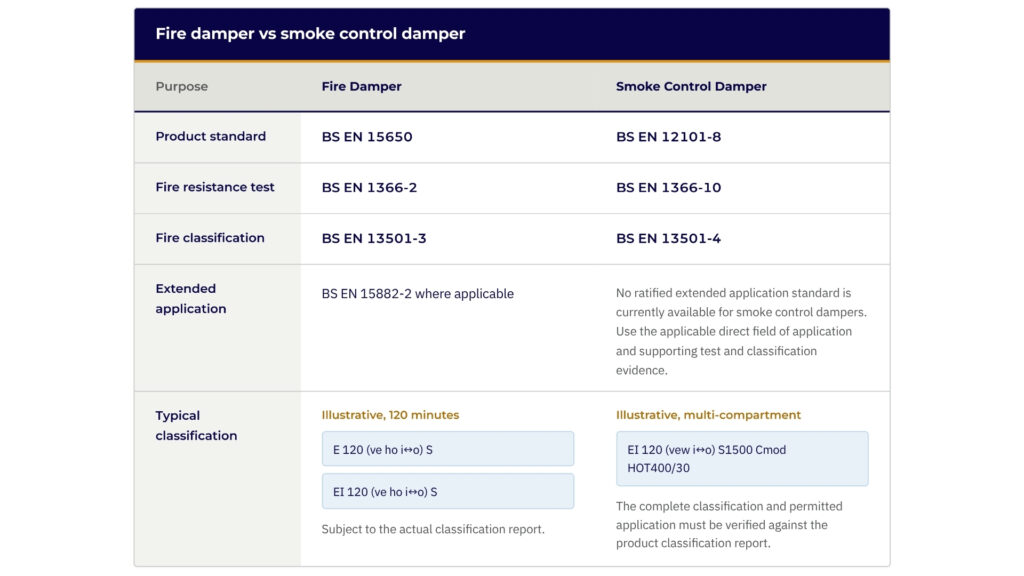
Fire damper:
E 120 (ve ho i↔o) S describes integrity for 120 minutes, vertical and horizontal applications and exposure from either side, with smoke leakage performance.
EI 120 (ve ho i↔o) S adds insulation performance. These are examples of classification format, not claims that every BSB damper has all these fields.
Smoke control damper:
BS EN 13501-4 distinguishes classifications for single-compartment and multi-compartment applications. Illustrative full-form examples are
E₆₀₀ 120 (vedw) S1500 Cmod HOT400/30 (single compartment)
EI 120 (vew i↔o) S1500 Cmod HOT400/30 (multi-compartment).
These are examples of how designations can appear together
Reading the example: E₆₀₀ identifies integrity assessed under the 600°C smoke-control test condition; EI denotes integrity and insulation; 120 is the stated duration in minutes; ve denotes vertical installation; dw/w and i↔o identify specific duct/wall arrangements and exposure directions where supported; S1500 is a smoke-leakage designation; Cmod describes an operating reliability/cycling category; and HOT400/30 denotes a high-temperature operating capability where classified. Not every product has these suffixes. Their precise meanings, combinations and applicability must be checked against the manufacturers declaration of performance which should be freely available via their website.
For a smoke-control system, the classification must also match the intended operating sequence: a damper may need to open on the fire floor and close elsewhere, rather than simply closing upon detection. The fire strategy and system cause-and-effect matrix govern that requirement.
The examples above are illustrative only.
BS EN 1363-1 provides general fire-resistance testing principles and may be referenced by the specialist test methods. It is not a standalone fire-damper or smoke-control-damper product, test or classification route and is therefore not included as a principal product-specific standard in the comparison.
An ES-rated fire damper cannot be assumed to be a smoke control damper. Likewise, a smoke control damper cannot automatically replace a fire damper at an ordinary ventilation penetration. The required application and supporting evidence must be established first.
E refers to integrity: the ability to resist the passage of flames and hot gases under the relevant test criteria. I refers to insulation: a separately assessed limitation on temperature rise. S refers to smoke leakage performance under the applicable classification route. These characteristics are not interchangeable.
For fire dampers, E 120 (ve ho i↔o) S describes a tested integrity and smoke-leakage classification for 120 minutes in the stated orientations and exposure directions. EI 120 (ve ho i↔o) S additionally includes insulation performance. The exact classification must be taken from the product’s supporting documentation.
Selecting a damper with the required classification is only part of the specification process. The wall or floor construction, orientation, dimensions, penetration seal, duct connections, fixing arrangement and access for inspection and maintenance all matter.
A classification is not permission to install a product in every wall or floor. The proposed arrangement must be covered by the manufacturer’s relevant test, classification and permitted field-of-application evidence. Changes in supporting construction, including board type, should not be assumed acceptable without appropriate supporting evidence.
For smoke control dampers, the system operating sequence, power supply, controls, fire alarm interface and commissioning arrangements are equally important. The required open and closed positions must follow the engineered smoke-control strategy.
At BSB Engineering Services, we believe effective damper specification follows a clear sequence:
The objective is not simply to select the highest available classification. It is to select the right solution for the building, supported by appropriate performance and installation evidence.
As fire safety design and compliance requirements continue to evolve, early engagement between designers, manufacturers and contractors remains essential.
BSB Engineering Services provides technical support to help customers understand fire damper performance, smoke control applications, product selection and installation evidence.
Contact our technical team to discuss damper selection, the applicable classification and the evidence needed to support your proposed installation.
